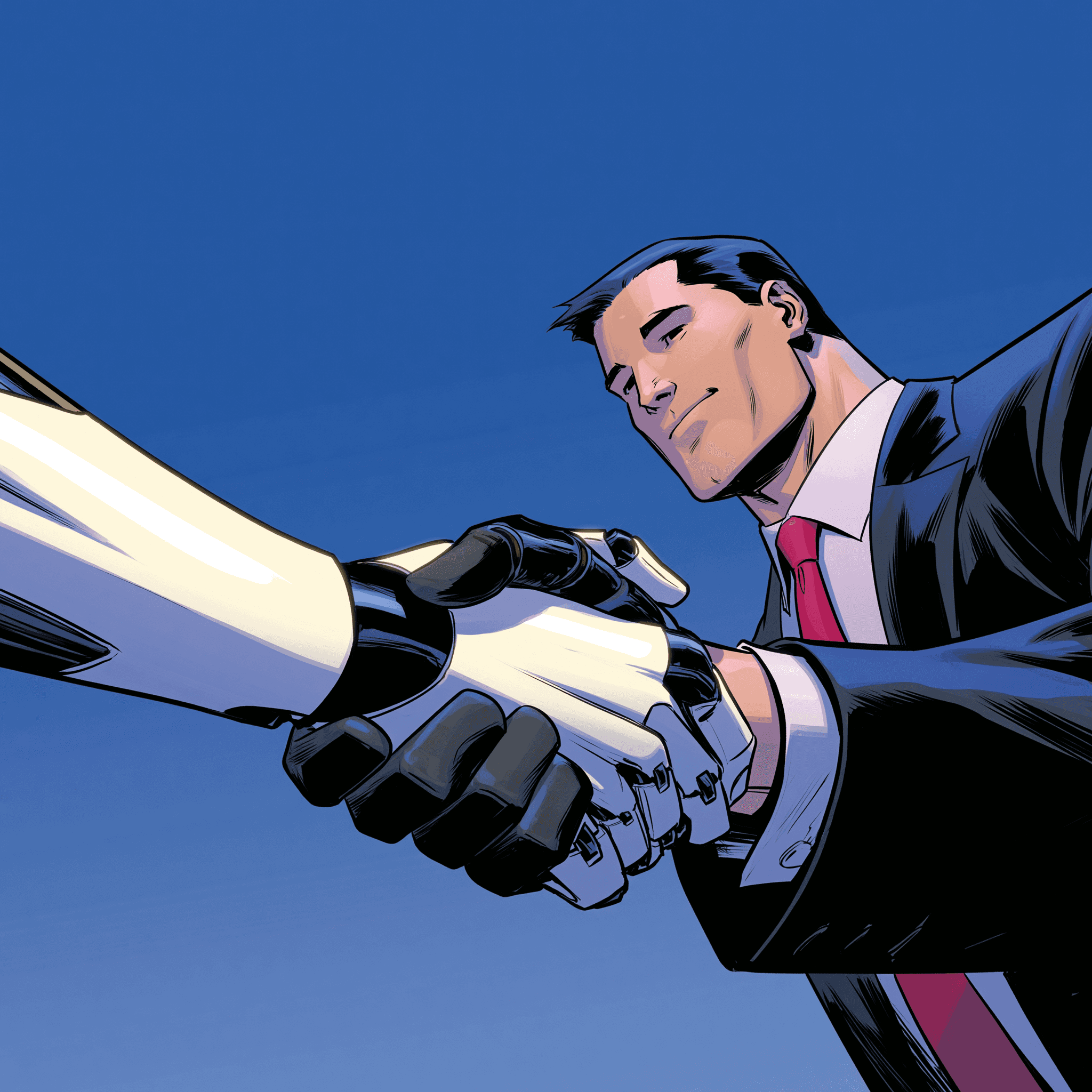
Sales is a game of hidden information
Sales cycles are driven by things no CRM field can capture: fit, urgency, sentiment, momentum. What a self-driving RC car taught me about inferring hidden state, and why the future of the pipeline is a learned policy, not another dashboard.

What self-driving taught me about closing deals
Before I worked on deep reinforcement learning at Microsoft R&D, I spent a couple of years building an autonomous RC car. Deep reinforcement learning handled the driving. Fuzzy logic handled emergency braking, because when something appears in front of you the decision has to be immediate and it has to be safe, and that is not a job for a learned policy (especially my first tries).

I have also spent twenty years running sales teams. I founded my first company in 2005, and apart from stints at Microsoft and Salesforce, I have been leading sales for most of my working life.
For a long time these were two separate parts of my life with nothing to say to each other. Then one of them answered a question the other had been asking for two decades.
The question everybody should be asking
Every sales leader I know has the same handful of people carrying the number. Not most of the team. A few. The best reps carry more pipeline, they lose less of it, and they close faster, and the distribution across a team is not a gentle slope. It is a cliff.
The standard answer is to hire more of the good ones and let the others go. I have done this. Everyone has done this. And it does not work the way it is supposed to, for a reason that has nothing to do with willingness.
The problem is not hiring good reps. It is finding them, and then getting them up to speed before they leave for someone else. By the time an excellent rep is fully productive in your market, with your product, against your competitors, a significant part of their tenure is already behind them. Then they move on and you start again.
So you are not really building a team. You are renting one, briefly, at the top of its value.
Which leaves the question everybody should be asking themselves. How do you make the rest of the team perform like the best ones?
Methodology and intuition
Ask a great rep how they do it and they will tell you it is instinct. I think they are being accurate, not evasive.
What they are doing is two things at once: a methodology, and an intuition.
The methodology is the part that can be written down. It is the sequence of things that has to become true before a deal can move. The metrics established, the economic buyer identified, the decision criteria understood, the champion found. MEDDIC and every serious methodology since is an attempt to name this. What none of them can tell you is where a particular deal stands against it right now, and what is missing this week.
The intuition is everything else, and it is mostly about reading the customer. Hearing which objection is the real one and which is a placeholder. Knowing from a pause that the person on the call is not the person who decides. Sensing that a competitor has been in the room. And then anticipating: a strong rep knows that at some point a competitor will make a particular argument to demote your solution, so they plant an idea three weeks early, in a conversation that appears to be about something else, so that when the argument arrives it lands on prepared ground.
Press enter or click to view image in full size
That intuition is built from deals lived through, and a couple of dozen of them is enough to start. Which is precisely why a new rep cannot have it yet.
Here is the division that matters, and it is the one we build around. The rep owns the customer. The Quarterback runs the CRM. The intuition is magic that stays with the human. The methodology is what gets captured and optimized.
The CRM takes a picture. Sales is a motion.
Here is what a CRM gives you. An opportunity exists. It is in stage three. It is worth $60,000. Someone updated it eleven days ago.

That is a picture. It is an accurate picture, and the underlying data is all there: the activity history, the stage transitions and when they happened, the emails and meetings and the gaps between them. Nothing is missing.
But a picture cannot show motion. A deal score tells you where a deal stands. It does not tell you which direction it is moving, or how fast, or whether the last two weeks helped. And an activity count tells you how much a rep did, not whether any of it was worth doing.
The components exist. Nobody assembled them.
This is where I want to be careful, because there is a lazy version of this argument that says the existing tools are wrong. They are not.
Forecasting tools produce a probability for a deal. Conversation intelligence produces a reading of how a call went. Engagement tracking produces a measure of how much contact there has been. Each of these is a real signal about something you cannot see directly, and each is genuinely useful.
The problem is that they are treated as answers. A number arrives on a dashboard, a human looks at it, and that is the end of the chain. Nobody has taken the deal score, the call sentiment, the engagement pattern, the stage history, and the methodology completion, and assembled them into a single description of what is actually going on with this deal right now.
The reason dynamics are hard is that almost nothing driving a deal is visible. How well the product genuinely fits the customer’s problem, which a rep can influence by selling the roadmap or getting a feature built, but only with difficulty. How urgent the customer feels, which drifts week to week. How they feel about you right now, which fades on its own and gets shocked by every interaction. How far the deal has come against the methodology, which has to be rebuilt at every stage.
None of that is a field in Salesforce. But all of it leaves traces, and the existing tools are already measuring several of those traces quite well.
What nobody has done is treat these as the hidden state of a system that evolves over time.
Because the more carefully you look at a sales cycle, the more it looks like a Markov process with hidden state. And a CRM, without ever intending to, has already done half the work: it has discretized a continuous process into a sequence of snapshots. Every activity, every stage change, every update is a step.
So the missing piece is not another number. It is reading the CRM properly, understanding what all of it means together, and building the setting in which a policy can be learned: a state vector where the score, the sentiment, the cadence, and the methodology all take their place, and an agent that decides what to do next from it.
That is what deep reinforcement learning was built for. You cannot observe the state, so you infer it from everything you can observe, and you learn a policy over that inference.
What we built
Dynamiks builds an AI coworker for sales teams. We call him the Quarterback.
He reads how a deal has moved since it was created, rather than scoring it where it stands. He pulls together everything the CRM and its neighbours know about that deal, infers what is going on underneath, works out what is missing, and builds the plan with the rep. Then he acts on it, creating, moving, and closing opportunities in Salesforce and HubSpot, so the record stays current without anyone maintaining it by hand.
A language model does the reasoning. Deep reinforcement learning does the deciding, trained in a simulator we built because an agent needs on the order of fifteen thousand deal trajectories to converge, and no real CRM will ever produce them at that rate.
Connecting all of it together produces two units that no CRM can generate on its own.
Impact is the dollar value of a single action. Every call, every meeting, every email moves a deal, positively or negatively, and now that movement has a number attached to it. Think acceleration.
Momentum is what Impact accumulates into: the velocity of a deal. When you act, it builds. When you wait, it drains.

From those two units, everything else becomes legible. You can see the impact of a single meeting. Of a rep’s week. Of a team’s quarter. Which deals are accelerating and which are quietly cooling. Where the next hour is worth the most, and where it is worth nothing. All of it in real time, in dollars, at the opportunity level, the rep level, and the team level.
That is what a picture could never give you, and it is not a dashboard. It is the measurement layer that makes the pipeline operable.
I should be honest about what is still hard. The simulator captures dynamics, not the idiosyncrasies of any particular company, so we retrain on each customer’s own history before deployment.
The empty column
I recently mapped what kind of AI is actually running in every part of the sales cycle, sorted by what the models underneath produce. Predictive scoring gives you a probability. Retrieval gives you a ranked list. Speech models give you a transcript. Large language models give you a text.
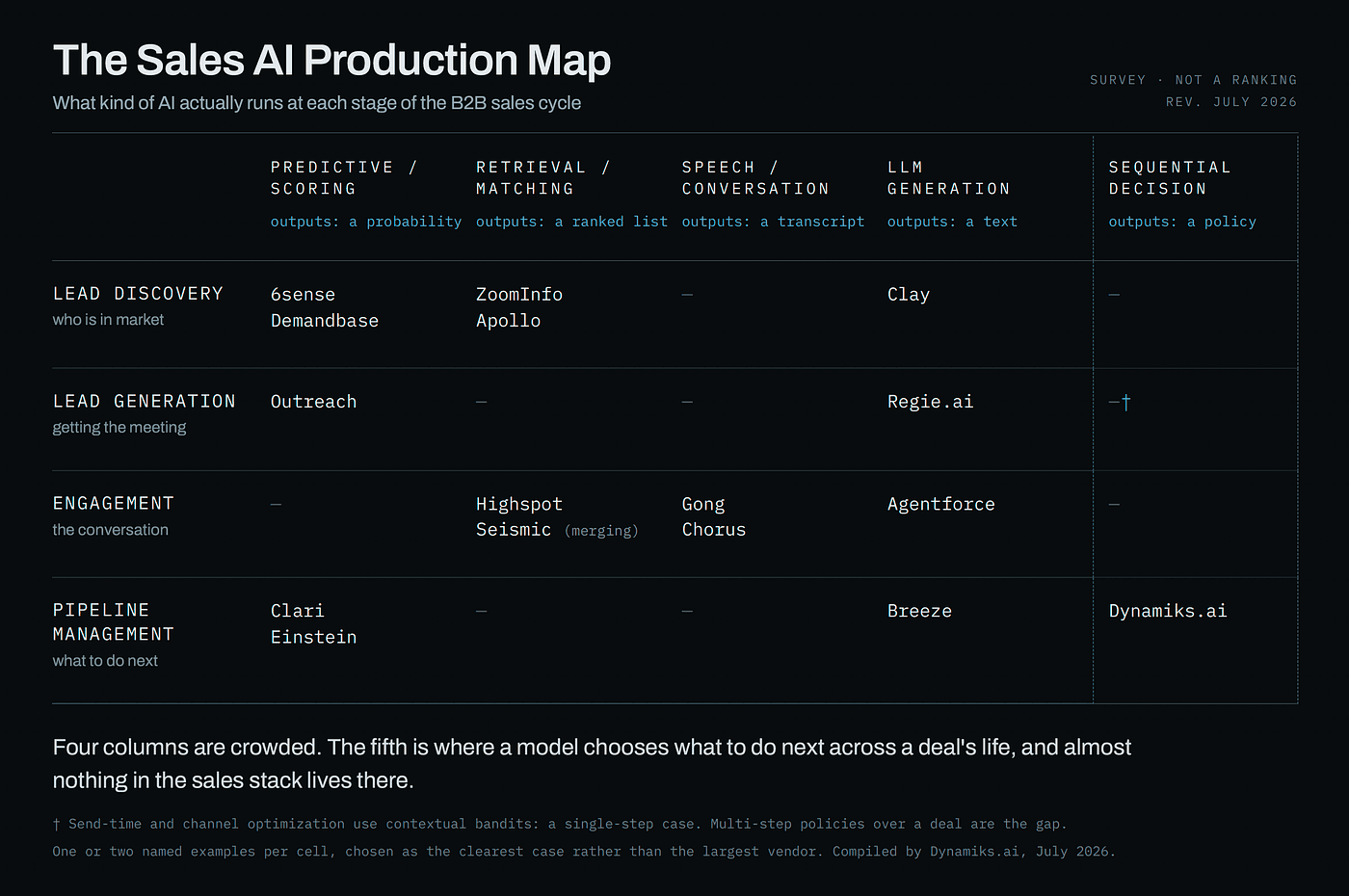
Four columns, crowded. Then a fifth, for models that produce a policy: a decision about what to do next, given everything that has already happened and everything that can be inferred about what has not been said. That column is nearly empty.
And if you build the fifth, you have the foundations of what I believe comes next in CRM: the self-driving pipeline. A record that maintains itself. A policy that decides where the next hour goes. A measurement layer that tells you, in dollars, whether the decision was right. The division of labour is the one I learned on the car: the learned policy does the driving, and the human keeps their hands on the wheel. In sales, the policy runs the pipeline. The human keeps the customer.
I spent twenty years on one side of this problem and a few years on the other. The answer was sitting in the gap between them the whole time.
Nicolas Maquaire is the co-founder and CEO of Dynamiks. He previously founded EntropySoft, acquired by Salesforce, and worked on deep reinforcement learning at Microsoft R&D.